


| Received | : | June 27, 2025 |
| Accepted | : | July 31, 2025 |
| Published Online | : | Aug 07, 2025 |
| Journal | : | Journal of Surgery Case Reports |
| Publisher | : | MedDocs Publishers LLC |
| Online edition | : | http://meddocsonline.org |
Cite this article: Aiwanlehi E, Nathan M, Newton OI. Foreign Body Ingestion in a Child: Outcome of Non-Operative Management. J Surg Case Rep. 2025; 3(2): 1011.
Foreign Body (FB) ingestion is a common paediatric emergency, especially in children under three years. While most cases are benign and managed conservatively, the object’s nature and location often guide clinical decisions. We report a 19-month-old female who presented after ingesting a metallic nail. She had no symptoms of obstruction or perforation, and the examination was unremarkable. A prior abdominal radiograph showed the nail in the stomach, and a repeat at presentation showed migration to the terminal ileum. She was managed conservatively with nil per oral, intravenous fluids, observation, and serial radiographs. She remained asymptomatic and passed the nail spontaneously by the third day, after which she was discharged in good condition. This case highlights the importance and effectiveness of non-operative management in asymptomatic children with blunt foreign body ingestion and evidence of progression through the gastrointestinal tract.
Keywords: Foreign body ingestion; Nail; Children; Non-operative management.
Foreign Body (FB) ingestion in children is widespread and it is a common cause for presentation to the children’s emergency unit. Children access objects by tasting and swallowing them [1]. The reported peak age of occurrence of FB ingestion ranges from 6 months to 3 years, and no sex predilection has been reported [1,2]. About 98% of foreign body ingestion is accidental [3], with 80%–90% of FBs in the Gastrointestinal (GI) tract passed spontaneously without complications. About 10%–20% of the FBs in the GI tract are removed endoscopically, and 1% require open surgery secondary to complications [4].
The risk for FB retention, possible obstruction, and perforation is higher in children with congenital malformations, previous gastrointestinal surgeries, and neuromuscular disorders [5]. The nature of FB swallowed by children differs according to regions and cultures. In the United States of America, a coin is the most swallowed object while fish bones are the most ingested in southern China [6].
The initial imaging modality for evaluation of FB in the GIT is a plain radiograph [7]. Computed tomography (CT) scan and Magnetic Resonance Imaging (MRI) may also be used. Foreign body ingestion is a common pediatric emergency with significant public health implications due to its potential for serious complications and healthcare burden. Early recognition and effective non-operative management can prevent morbidity and reduce the need for invasive procedures.
A 19-month-old female presented to our children’s emergency department following ingestion of a foreign body (nail). She had no history of abdominal pain, abdominal distension, vomiting, or haematochezia. She was afebrile, not pale, not dehydrated. Her vital signs were stable with a pulse rate of 120 beats/min and respiratory rate of 36 cycles/min. On examination, the abdomen was full and moved with respiration with no area of tenderness. The bowel sounds were normoactive.
She presented with a plain abdominal radiograph which showed a FB (nail) in the body of the stomach (Figure 1) This was done about 6 hours prior to the presentation at our facility. A repeat radiograph done at the presentation showed the FB (nail) at the region of the terminal ileum (Figure 2). She was commenced on nil per oral, intravenous fluids and monitoring (clinical and radiological). She had two additional plain abdominal radiographs, (Figure 3, 24 hours on admission) and (Figure 4, on day 3). The vital signs remained stable and the abdominal examinations remained equivocal throughout the period of admission. She was discharged following a repeat radiograph which showed no evidence of FB in the GIT.
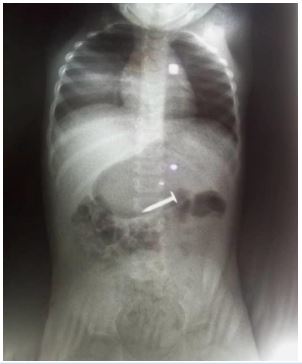
Figure 1: AP view of plain abdominal radiograph (6 hours prior to presentation).
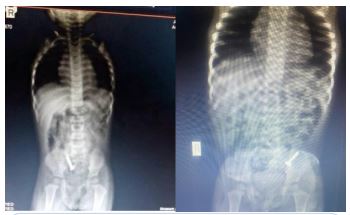
Figure 2: AP + Lateral view of plain abdominal radiograph. (Done at presentation).
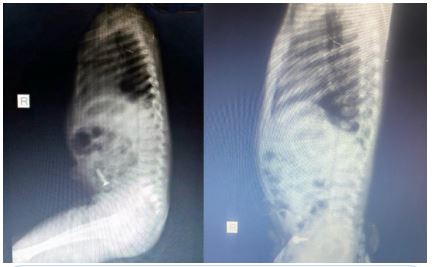
Figure 3: AP + Lateral view of plain abdominal radiograph. (24 hours admission).
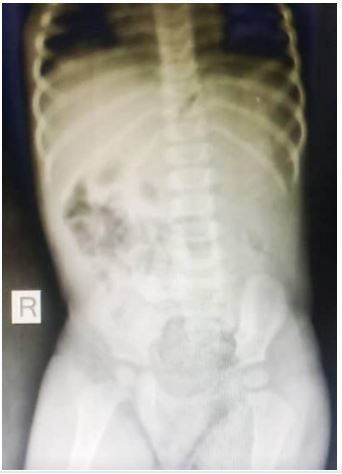
Figure 4: AP view of plain abdominal radiograph (Day 3).
FB ingestion is sometimes a difficult diagnosis to make in the paediatric population [8], as small children cannot vocalize, and the caregivers may not witness the ingestion. Diagnosis of FB therefore requires a high index of suspicion. FB ingestion causes parental anxiety. Recurrent FB ingestion has been noted to occur in children who have mental challenges [9]. Determining patients who would require intervention from those that can be safely observed poses a challenge in the management of FB ingestion. The management of FB in the GIT is majorly dependent on the clinical experience of the attending physician [9].
Most patients are between 6 months and 3 years old [1], with the peak incidence between 1 and 2 years. The occurrence of FB ingestion decreases gradually from 6 years onwards.
The American Association of Poison Control Centers in 2002 reported that 75% of over 116,000 FB ingestions occurred in children aged ≤5 years [10]. Since ingestions usually occur accidentally in otherwise healthy children, Age, therefore, remains the primary risk factor for FB ingestion in children.
Yalçin et al., reported a mean age of 2.27 ± 2.84 years old, with a male: female ratio of 1.1:1.0 [11]. Khorana et al. found that 53.6% of their study cases were males while 46.4% were females with a median age of 3.66 years [12].
Coins are the most frequently ingested objects, though other commonly encountered items include buttons, beads, nails, food boluses, bones, and button batteries [6]. Symptomatology often correlates with the location of the foreign body. While gastrointestinal FBs are frequently asymptomatic, esophageal FBs tend to present with more obvious symptoms [13].
Children with FB in the GIT may present with vomiting, abdominal pain, and passage of bloody stool. Fever and weight loss could be present in cases of prolonged FB ingestion in the GIT [14].
Plain abdominal radiography remains the first-line imaging modality for suspected FB ingestion due to its wide availability, affordability, and ability to detect most radio-opaque objects [15]. However, radiolucent objects such as plastic and wood may be missed, necessitating the use of abdominal ultrasound for improved detection. Computed Tomography (CT) offers precise three-dimensional localization of FBs, though its use is limited by cost and radiation exposure [16,17]. In the case presented, only plain abdominal radiographs were performed, as the ingested object, a nail was radio-opaque and easily visualized. Certain factors such as size and shape of FB, adhesions from previous abdominal surgeries, or congenital conditions like intestinal stenosis may affect the passage of objects through the GIT [18,19].
Nonetheless, fewer than 1% of patients who ingest foreign bodies require surgical intervention [4]. Surgery is generally indicated in symptomatic presentation, complications, or when the FB fails to progress after three days. During surgical exploration, particular attention should be paid to anatomically narrow regions such as the pylorus, ligament of Treitz, ileocecal valve, and rectosigmoid junction [20].
Surgical treatment involves performing an enterotomy in a fresh area (not over the FB) to avoid dehiscence. The repair of the enterotomy should be conducted in two layers to prevent breakdown and leakage of intestinal contents.
Non-operative management of foreign body ingestion has proven to be effective and safe in the majority of cases, particularly when timely diagnosis and appropriate monitoring are ensured. Most ingested foreign bodies pass spontaneously without the need for surgical intervention, reducing patient morbidity and healthcare costs. However, careful patient selection, vigilance for complications, and clear management protocols remain essential to achieving optimal outcomes.
Acknowledgments
The authors thank the patient for consenting to this publication and Irrua Specialist Teaching Hospital for their support.
Author contributions
E.A. contributed to writing, review & editing. M N. contributed to writing, review & editing. O.I.N. contributed to writing, review & editing. All authors read and approved the manuscript.
Conflicts of interest
The authors declared no competing interest.
Funding statement
This research received no specific grant from any funding agency in the public, commercial or non-profit organization.
Data availability
We obtained permission from the patient’s family to use all the materials for this case report and all materials used belong to the archive of the hospital in this case report.
Consent for publication
We have written and verbally obtained consent to publish from the patient’s family for this case report.
We always work towards offering the best to you. For any queries, please feel free to get in touch with us. Also you may post your valuable feedback after reading our journals, ebooks and after visiting our conferences.

