


| Received | : | Jan 13, 2026 |
| Accepted | : | Jan 26, 2026 |
| Published Online | : | Feb 02, 2026 |
| Journal | : | Journal of Gynecology Case Reports |
| Publisher | : | MedDocs Publishers LLC |
| Online edition | : | http://meddocsonline.org |
Cite this article: Muchaku M, Hirose A, Fudono A, Tsurane K, Sekiguchi M, et al. Severe Neonatal Anemia Caused by IgM-type Anti-M Antibody. J Gynecol Case Rep. 2026; 5(1): 1023.
Anti-M antibody is an irregular antibody directed against the M antigen of the MN blood group. Most anti-M antibodies are of the immunoglobulin M type, which does not cross the placenta; however, rarely, the immunoglobulin G type can cause severe fetal anemia. A 29-year-old pregnant woman with immunoglobulin M-type anti-M antibodies underwent an emergency cesarean section at 35 weeks due to non-reassuring fetal status with pleural effusion and ascites. The neonate’s hemoglobin was 1.4 g/dL, and immunoglobulin M-type anti-M antibodies were detected in the serum. Neither the mother nor the neonate had Immunoglobulin G-type anti-M antibodies. Laboratory findings excluded fetomaternal transfusion. Clinical course and laboratory findings, which suggested suppressed bone marrow erythropoiesis without marked hemolysis, indicated that Immunoglobulin M anti-M antibodies may have caused the severe fetal anemia. Routine monitoring for fetal anemia is recommended in pregnancies with anti-M antibody positivity, even when only immunoglobulin M-type antibodies are present.
Keywords: Dithiothreitol treatment; Fetal anemia; IgG antibodies; MN blood group; Prolonged anemia.
The MN blood group is a complex red blood cell antigen system composed of > 40 antigens. Anti-M antibodies are irregular antibodies directed against the M antigen of this system. Most anti-M antibodies are of the Immunoglobulin (Ig) M type, which react at 4–22°C and are considered unable to cross the placenta. However, in rare cases, IgG-type anti-M antibodies, which react at 37°C, have been detected [1]. Even at low titers, maternal IgG-type anti-M antibodies cause severe neonatal anemia. We report a case of a neonate born to a mother in whom only IgM-type anti-M antibodies—and not IgG—were identified, who presented with severe anemia; the same IgM-type anti-M antibodies were also detected in the neonate. To our knowledge, this is the first reported case of severe neonatal anemia without detectable IgG-type anti-M antibodies, with only IgMtype present.
The mother was a 29-year-old primigravida with no history of transfusion, past illness, or relevant family condition. Screening at 12 weeks of gestation revealed the presence of anti-M antibodies; however, as they were reactive only at low temperatures, their clinical significance was considered minimal, and standard management was continued. At 26 weeks, the estimated fetal weight was 764 g (−1.6 Standard Deviation (SD)), suggesting fetal growth restriction; growth thereafter remained between −1.6 SD and −1.8 SD. At 29 weeks, placenta previa was diagnosed, and a cesarean section was scheduled at 36 weeks. At 35 weeks and 5 days, fetal heart rate monitoring showed absent baseline variability (Figure 1a), and ultrasound revealed fetal cardiomegaly, pleural effusion, and ascites (Figure 1b-c). Emergency cesarean section was performed for non-reassuring fetal status and placenta previa.
A female neonate weighing 2178 g (−0.4 SD) was delivered with Apgar scores of 3 and 4 at 1 and 5 min, respectively. The neonate exhibited marked pallor, and the placenta (1040 g, +3.8 SD) appeared pale. Laboratory testing revealed severe anemia, with a Hemoglobin (Hb) level of 1.4 g/dL. IgM-type anti-M antibodies were detected in the neonatal serum, whereas the direct antiglobulin test was negative. Maternal and neonatal MNSs blood group phenotypes were NN and MN, respectively. Serological tests for parvovirus B19, cytomegalovirus, toxoplasmosis, and rubella were negative. Feto-Maternal Transfusion (FMT) was suspected; however, the maternal level of fetal hemoglobin (HbF) was 1.7%—mildly elevated compared to the average (< 1.0%)—and α-Fetoprotein (AFP) was 196 ng/mL, lower than values reported in confirmed FMT cases. The neonate received a blood transfusion of 35 mL/kg red cell concentrate on days 0–1, with Hb rising to 15.9 g/dL by day 3. However, anemia was noted on days 24 and 36 (Hb 7.2 and 9.0 g/dL) (Figure 2). Dithiothreitol treatment, which is used to specifically detect IgG-type anti-M antibodies, was negative in both mother and neonate. The neonatal peak total bilirubin rose to 6.6 mg/dL on day 5 and LDH to 630 U/L on day 2; phototherapy was not required. Despite the severity of anemia, reticulocyte counts were low at 2.2‒7.0‰ (normal range: 2‒26‰). Although transfusion temporarily improved anemia, it recurred after a short period, suggesting suppression of erythropoiesis at the marrow level. Thus, the severe anemia was attributed to anti-M antibodies. Head magnetic resonance imaging on day 17 revealed no abnormalities related to severe anemia or hypoxic-ischemic encephalopathy. The final blood transfusion was administered on day 44, and the infant was discharged on day 46. At outpatient follow-up, age-appropriate motor development was confirmed at 4 months.
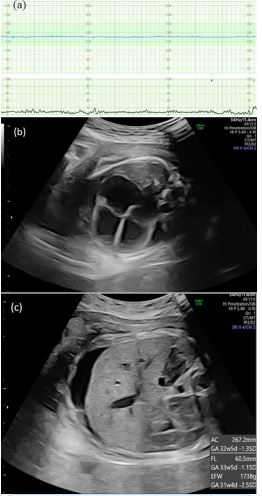
Figure 1: Cardiotocography and fetal ultrasound at 35 weeks and 5 days of gestation. (A) Fetal heart rate showed absent baseline variability. (B) Ultrasound revealed a cardiothoracic area ratio of 40.4%, indicating fetal cardiomegaly, and (C) Pleural effusion and ascites.
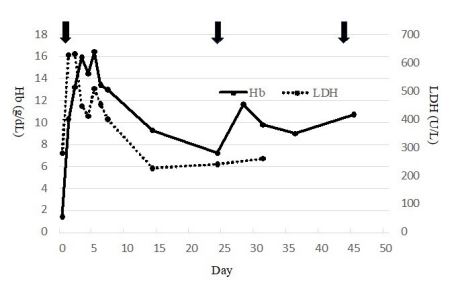
Figure 2: Changes in Hb and LDH from day 1 to 45. The neonate received a transfusion of 35 mL/kg red cell concentrate on days 0–1, resulting in an Hb increase to 15.9 g/dL by day 3. Anemia recurred on days 24 and 36 (Hb 7.2 and 9.0 g/dL).
The most frequent cause of fetal anemia is alloimmunization. Reported causes include infections such as parvovirus B19, cytomegalovirus, and toxoplasmosis; inherited disorders such as lysosomal storage diseases, Diamond–Blackfan anemia, Fanconi anemia, thalassemia, and congenital erythrocyte membrane disorders; as well as FMT, aneuploidy, twin anemia polycythemia sequence, and placental or fetal tumors [2]. After excluding other causes, possible causes of severe anemia were alloimmunization, Diamond–Blackfan anemia, and FMT.
Initially, FMT was suspected. Two methods are available for estimating blood loss in FMT: the Mollison (based on maternal HbF) [3] and the neonatal Hb methods [4]. Using the Mollison method, the estimated transplacental hemorrhage was 40.8 mL, whereas the neonatal Hb method yielded 178.9 mL, assuming a circulating blood volume of 90 mL/kg for a preterm neonate and a normal Hb concentration of 16 g/dL. This discrepancy suggests only a slight increase in HbF. Furthermore, as AFP remained within the normal range, the likelihood of FMT was considered low. Although the anemia was extremely severe, the neonate required only standard treatment after several transfusions, making Diamond–Blackfan anemia unlikely. Anemia improved temporarily after transfusion; however, it recurred after a short period. Therefore, we suspected suppression of erythropoiesis at the bone marrow level and concluded that anti-M antibodies were the most likely cause of severe neonatal anemia.
The MN antigens are expressed on membrane proteins such as glycophorin A and C, which are present on both mature red blood and early erythroid progenitor cells. Anti-M antibodies may therefore target erythroid progenitor cells, suppress their proliferation, and cause severe late-onset neonatal anemia by reducing erythropoiesis. Studies indicate that neonates with Hemolytic Disease of the Fetus and Newborn (HDFN) due to anti-M tend to have low reticulocyte counts at birth, unlike cases of typical hemolytic anemia [5]. Previous studies have also reported that anti-M HDFN is not associated with a marked increase in total bilirubin during onset [6]. Although hemolysis due to antigen-antibody reactions can cause jaundice, suppression of erythropoiesis reduces red blood cell destruction, thereby weakening the correlation between anemia severity and jaundice. In our case, the reticulocyte count was disproportionately low, hemolysis was mild, and jaundice did not require phototherapy, suggesting suppression of erythropoiesis at the bone marrow level.
Theoretically, only IgG antibodies can cross the placenta, whereas IgM antibodies cannot. Previous reports of fetal anemia caused by anti-M antibodies have identified either IgG-type or both IgM/IgG-type antibodies [6]. In this case, only low-temperature reactive anti-M antibodies (IgM-type) were detected in both the mother and neonate. To confirm the presence of IgG-type antibodies, we performed additional dithiothreitol treatment, which inactivates IgM and allows for the detection of IgG antibodies that would otherwise be missed by standard methods; however, no IgG antibodies were identified. Typically, IgM antibodies are early immune responders, present in trace amounts after approximately 20 weeks of gestation, but rarely present immediately after birth. Unusually, in this case, low-temperature reactive anti-M antibodies were detected in the neonate at birth, suggesting that IgM-type anti-M antibodies may have been produced in the fetus before delivery. These findings support the possibility that IgM-type anti-M antibodies crossed the placenta and contributed to severe neonatal anemia, despite the conventional view that IgM generally cannot traverse the placental barrier.
We propose two hypotheses regarding the mechanism by which IgM may have been transferred. The first involves fetal microchimerism, defined as the persistence of fetal-derived cells in maternal blood and tissues after delivery. During pregnancy, bidirectional cell trafficking occurs [7], which could explain the presence of IgM-producing plasma cells in maternal blood that subsequently migrated to the fetus. Plasma cells are the terminal stage of B-cell differentiation and secrete antibodies. Although most persist for only a few days, recent studies suggest they can survive for weeks to years within dedicated survival niches [8]. The second hypothesis involves a mutation in the neonatal Fc receptor (FcRn), which mediates IgG transport from mother to fetus. Normally, FcRn selectively transfers IgG across the placenta, but functional alterations could permit aberrant IgM transfer.
Finally, we address why the low-temperature-reactive IgMtype antibody reacted at body temperature in this case. Although rare, the presence of anti-M antibodies that react at 37°C has been reported [9]. One study has demonstrated that IgM-type anti-M antibodies react more strongly at 37°C than at lower temperatures [10]. Therefore, in this case, IgM-type antiM antibodies likely caused fetal anemia.
We describe a case of severe neonatal anemia associated with maternal IgM-type anti-M antibodies, with antibodies detected in the neonate. Routine monitoring for fetal anemia should be considered in pregnancies with anti-M antibody positivity, regardless of whether the antibodies are IgM- or IgG-type.
Ethical approvals and statements
Case reports need no ethics approval if patient data are unidentifiable.
Consent
Written informed consent was obtained from the patient for the publication of her deidentified data and images.
Acknowledgments
We sincerely thank Dr. Michiko Kajiwara, Center for Transfusion Medicine and Cell Therapy, Institute of Science Tokyo Hospital, for her invaluable advice on case management. Her contributions were crucial to the progress of this research. We are also grateful to Drs. Chikako Morioka, Manabu Sugie, and Kazuyuki Ito, Department of Pediatrics, for their care of the neonate and insightful discussions on pathophysiology. We also thank Editage (www.editage.jp) for English language editing.
Disclosure
The authors declare no conflict of interest.
We always work towards offering the best to you. For any queries, please feel free to get in touch with us. Also you may post your valuable feedback after reading our journals, ebooks and after visiting our conferences.

