


| Received | : | Jan 02, 2026 |
| Accepted | : | Feb 02, 2026 |
| Published Online | : | Online: Feb 09, 2026 |
| Journal | : | Annals of Ophthalmology and Visual Sciences |
| Publisher | : | MedDocs Publishers LLC |
| Online edition | : | http://meddocsonline.org |
Cite this article: Van Anh BT, Loan DP, Hung BV. How Vascular Density Correlates to Visual Field Defects in Posner Schlosman Syndrome-A Case Study. Ann Ophthalmol Vis Sci. 2026; 9(1): 1053.
During high IOP term, vessel density diffusely reduces, particularly on the superficial layer, but doesn’t correspond to visual field defect. On the other hand, during the controlled IOP term, the loss of vessel area of ONH well corresponds to the VF defect.
Swept-source OCTA enables the acquisition of images down to the lamina cribrosa, as well as the clear separation of the vascular distribution between the layers. Therefore, SS-OCTA imaging can be used to determine the location of changes in vascular density, thereby identifying the source of damaged vessels or the source of pathology.
Keywords: ONH; SS-OCTA; DRI Triton; Vessel density; Superficial layer; Deeper layer.
The optic nerve head and retina are supplied by two vascular systems: the uveal vessels and the central retina vessels, which originate from the ophthalmic artery, a branch of the internal carotid artery.
The circulation in the Optic Nerve Head (ONH) is divided into superficial layers and deeper layers (prelaminar, lamina cribrosa, post-lamina area, and outer retinal layers). The blood of the superficial layer, supplied via small branches of the central retinal artery by creating a radial capillary network surrounding the optic disc, nurtures the nerve fiber layer and the inner retina (from ILM to IPL/ILN layer). The prelaminar area, lamina cribrosa, and outer retinal layers (from OS/RPE to Bruch membrane), however, are directly supplied by the capillaries that are exceptionally long and originate from short posterior ciliary arteries or branches from the choroidal arteries. Unlike the arterial supply, venous drainage of the ONH is through the central retinal vein.
DRI Triton SS-OCT device (Topcon, Tokyo, Japan) can analyze Vessel Density (VD) of the Optic nerf head area as deep as the lamina cribrosa, something that SDOCT is hard to do. By applying the Macular Angio protocol for scanning the vessels at ONH, we can get the vessel’s information inside a 1mm circle from the central retinal vessels, which we cannot reach by using only the Disc Angio protocol. In clinical practice, we use the Disc Angio protocol to survey the peripapillary vessel located between two concentric circles: a 2mm circle and a 4mm circle, with the center coinciding with the center of the optic disc. The Macular Angio protocol is used to get information about the Central ONH vessel within the optic disc margin or a 1 mm in diameter center circle. The Macular Angio protocol is also used to analyze the juxta-papillary vessels, which are located immediately adjacent to the optic disc margin, 1 mm wide, measured outwards from the central optic disc survey area (a circle with a diameter of 3 mm centered on the optic disc margin).
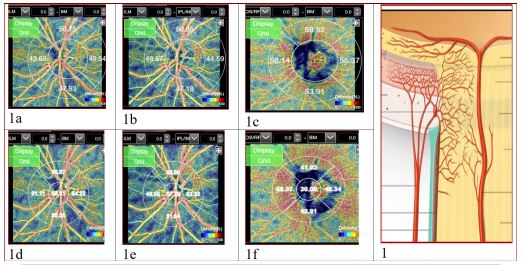
Figure 1: Vascular System of Optic Nerve Head
Optic nerve head vessel density of a normal person (19-yearold male, left eye)
Photos were taken using the Disc Angio protocol: 1a. vessel density of whole retinal thickness; 1b. vessel density of the superficial part of retina (from ILM to IPL/INL); 1c. vessel density of the deeper part of the retina (from OS/RPE to Bruch membrane)
Photos were taken using the Macular Angio protocol: 1d. vessel density of whole retinal thickness; 1e. vessel density of the superficial part of retina (from ILM to IPL/INL); 1f. vessel density of the deeper part of the retina (from OS/RPE to Bruch membrane)
Had finished the treatment for shingles on the right half of the face 10 days ago, a 56-year-old female came to check her eyes because of pain in the right eye, lasting for 3 days
Her acuity vision changed rapidly to 20/100 with an IOP was 60 mmHg on the right eye, while the left eye was almost normal at 20/25 and IOP was 11 mmHg. There were some mutton precipitates and edema cornea on the right. Fundus, RNFL on OCT, and visual field were almost normal except for a small nasal step lesion on the right VF (Figure 2).
Figure 2: OCT and VF of right eye.
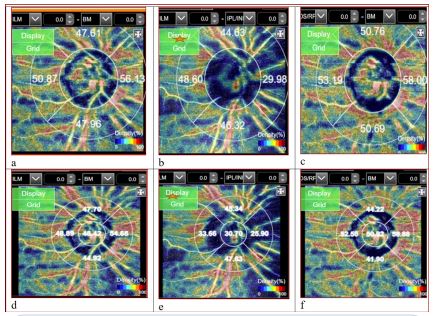
Figure 3: Vessel density of ONH in the right eye: diffuse ischemia in the nasal half of the superficial vascular layer (B-E), the deep blood vessels were almost unaffected (C-F).
OCTA images were taken to analyze the vascular system of ONH. The vascular density distribution plan showed a diffuse ischemia in the nasal half of the right eye, completely inconsistent with the damage in the visual field. This condition only occurred in the superficial vascular layer; the deeper vessels were almost unaffected.
The patient was diagnosed with Posner-Schlossman syndrome in the right eye. Having been treated with steroids and Azarga, and Acetazolamide 0.25g 2 tablets/day, the right eye’s IOP decreased to 11 mmHg.
After 3 days, the superficial optic nerve ischemia at the optic disc and around the optic disc significantly improved beyond the ischemic band at 5 o’clock. The location of this fixed ischemic lesion corresponded to the visual field defect of the right eye.
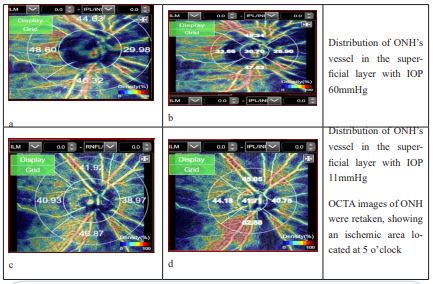
Figure 4: Distribution of ONH’s vessel in the superficial layer when IOP 60 mmHg (A,B) and IOP 11 mmHg (C,D).
Retinal blood flow depends not only on the perfusion pressure, which is the difference between retinal arterial and retinal venous pressure, but also on the level of intraocular pressure. The local resistance around ONH was high when IOP was 60mmHg and was reduced when IOP was 11 mmHg, resulting in a reverse increase in retinal vascular perfusion. During the high IOP term, some vessels were actually occluded and manifested as an avascular zone on the vascular distribution image when IOP was normal (Figure 4), which corresponded to VF defects (Figure 3). We hypothesized that, in the early stage of glaucoma, only the vessels on the superficial layer are damaged, but in the end stage, both vessels on the superficial and deep layers are damaged. Only the non-perfusion zone in the normal IOP term corresponds with defects of VF.
Acknowledge
Thank you for the participation of my colleagues, Optometrist. Duong Phuong Loan; Dr. Nguyen Duc Doanh, Dr. Bui Viet Hung (High-tech Eye Center, Hanoi Tam Anh General Hospital).
We always work towards offering the best to you. For any queries, please feel free to get in touch with us. Also you may post your valuable feedback after reading our journals, ebooks and after visiting our conferences.

