


| Received | : | Dec 21, 2025 |
| Accepted | : | Jan 07, 2026 |
| Published Online | : | Jan 14, 2026 |
| Journal | : | Annals of Hematology and Blood Disorders |
| Publisher | : | MedDocs Publishers LLC |
| Online edition | : | http://meddocsonline.org |
Cite this article: Al Ali F, Alfayez M, Owaidah T, Saad A, Hanbali A. Successful Integration of Venetoclax into AYA (CALGB 10403) Directed Therapy for T/Myeloid Mixed-Phenotype Acute Leukemia with Extramedullary Disease: A Case Report and Literature Review. Ann Hematol Blood Disord. 2026; 3(1): 1006.
Keywords: Mixed-phenotype acute leukemia; Venetoclax; AYA-protocol; CALGB 10403; Extramedullary disease, MRD.
Mixed-Phenotype Acute Leukemia (MPAL) is a rare and heterogeneous disorder characterized by the co-expression of lineage-defining antigens from more than one hematopoietic lineage, typically myeloid with B- or T-lymphoid markers. It accounts for fewer than 5% of all acute leukemias and carries an unfavorable prognosis due to its complex biology, high rates of chemoresistance, and lack of standardized treatment guidelines [1]. Within this category, the T/myeloid subtype represents one of the rarest forms, often presenting with aggressive clinical features and a propensity for extramedullary disease [2]. T-lineage MPAL carries a significantly worse prognosis than T-ALL and is prone to misclassification with ETP-ALL, underscoring the need for expanded diagnostic panels [3]. BCR::ABL1-positive MPAL often presents at a younger age and shows better outcomes with TKI use [4]. Single-cell transcriptome studies identified a stemness-high subtype responsive to venetoclax [5].
The optimal therapeutic approach for MPAL remains controversial. Recent multicenter and molecular studies further emphasize the heterogeneity of MPAL, with Acute Lymphoblastic Leukemia (ALL)-based regimens achieving superior remission rates compared to Acute Myeloid Leukemia (AML) regimens, although long-term survival remains poor, and allogeniec Stem Cell Transplant (allo-SCT) remains critical [6]. Allo-SCT in first remission is frequently advocated, particularly in younger patients, though achieving deep remission before transplant remains a significant challenge.
The emergence of targeted therapies has provided new opportunities to address the therapeutic gaps in MPAL. Venetoclax, an oral selective inhibitor of the anti-apoptotic protein BCL-2, has demonstrated substantial activity in both AML and relapsed/refractory ALL, particularly in the setting of Minimal Residual Disease (MRD) persistence. Early incorporation of venetoclax into induction or consolidation regimens has been associated with enhanced cytotoxicity and improved clearance of leukemic clones, including in cases with extramedullary involvement [7,8].
Here we describe the case of a young adult with T/myeloid MPAL and concurrent extramedullary disease, in whom venetoclax was integrated early alongside an ALL-adapted regimen. This approach not only facilitated MRD clearance but also addressed extramedullary disease, allowing the patient to proceed successfully to haplo-identical stem cell transplantation. This report highlights the potential role of venetoclax as an adjunct to frontline therapy in this challenging leukemia subtype.
A 20-year-old female with no significant comorbidities, presented in May 2025 with progressive fatigue, cervical lymphadenopathy, and cytopenia. Laboratory evaluation revealed a White cell Count (WBC) of 9.4 × 10^9/L, and peripheral smear showed 4–5% circulating blasts. Flow cytometry of peripheral blood demonstrated 4–5% blasts co-expressing CD7, CD5 (subset), CD13 (partial), CD15, CD33, CD34, CD117, CD38, CD200 (partial), CD305, and MPO, findings consistent with T/myeloid Mixed-Phenotype Acute Leukemia (MPAL). Bone marrow biopsy performed the following day was markedly hypercellular (80– 90%) with 58% blasts displaying an identical immunophenotype (Figure 1). Her karyotype revealed clonal del(6) and t(3;16) in 17/20 cells, while FISH was negative for common myeloid and lymphoid rearrangements. CNS evaluation with lumbar puncture and MRI was negative.
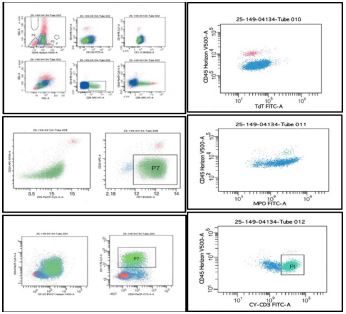
Figure 1: This immunophenotypic profile establishes both T-lineage commitment (cyCD3, CD7, TdT) and myeloid differen6a6on (MPO posi6vity). By WHO/ICC 2022 criteria, the presence of cytoplasmic CD3 defines T-lineage, while MPO expression defines myeloid lineage.
Imaging with PET-CT showed multiple FDG-avid supra- and infra-diaphragmatic lymph nodes (SUVmax 14.4) and mild splenomegaly (Figure 2). Biopsy of a right cervical lymph node confirmed T/myeloid sarcoma, with blasts positive for MPO, CD3, CD7, BCL2, and CD99, variably expressing CD5, CD117, and CD34, with focal TdT positivity and a Ki-67 index exceeding 90%. Given the high disease burden, debulking with flat-dose cytarabine (1 gram) was administered, followed by induction therapy using CALGB 10403, a pediatric-inspired ALL protocol (vincristine, daunorubicin, PEG-asparaginase, prednisone, intrathecal methotrexate and cytarabine) (9) combined with venetoclax escalated to 400 mg/day (Table 1).

Figure 1: PET-CT showed multiple FDG-avid supra- and infra-diaphragmatic lymph nodes (SUVmax 14.4) and mild splenomegaly.
 Table 1
Table 1: Remission Induction.
At day 28 evaluation, the bone marrow was hypocellular (10–20%) with 2% blasts. Minimal Residual Disease (MRD) analysis detected 0.7% residual myeloid population (CD117+, CD13+, CD33+, CD34^dim, HLA-DR+, CD15+, CD38+), while no T-lymphoblasts were identified. PET-CT demonstrated an excellent metabolic response with residual low-level uptake in bilateral cervical lymph nodes. Owing to persistent MRD and extramedullary activity, consolidation with Hyper-CVAD Part B ( High-dose Methotrexate and Cytarabine (Ara-C)) was administered in July 2025, together with continuation of venetoclax (Table 2). Repeat marrow examination demonstrated normocellularity (70–80%) with trilineage hematopoiesis and no morphologic or immunophenotypic evidence of disease; MRD was negative at the 0.01% threshold. Repeat PET scan showed complete metabolic resolution of prior (Figure 3).
The patient subsequently underwent mismatched related allogeneic peripheral blood stem cell transplantation from a cousin donor, conditioned with Total Body Irradiation (TBI) 10 Gy, fludarabine, with GVHD prophylaxis regimen as post-transplant cyclophosphamide/tactrolimus and mycophenolate.

Figure 3: PET-CT post HYPER-CVAD B + venetocloax demonstrated an excellent metabolic response with residual low-level uptake in bilateral cervical lymph nodes.
Table 2
Table 2: Hyper-CVAD Block B with Venetoclax
D+45 post-transplant assessment showed complete molecular remission on PET scan and Minimal Residual Disease (MRD) negativity by bone marrow biopsy (Figure 4).

Figure 4: PET CT post allogenic stem cell transplantation suggestive of a complete metabolic response.
Mixed-Phenotype Acute Leukemia (MPAL) represents one of the most challenging acute leukemias to diagnose and treat, owing to its biological heterogeneity, diagnostic overlap with other high-risk entities, and lack of standardized therapeutic algorithms. Large retrospective analyses confirm ALL-directed therapy improves remission, but allo-SCT remains essential [6]. Further comparative pathology work has underscored the unique challenges of T-lineage MPAL. In an analysis of 41 adult cases, T-lineage MPAL was associated with significantly poorer prognosis relative to conventional T-ALL, whereas Early T-Precursor (ETP) ALL demonstrated outcomes closer to T-ALL. Many T-lineage MPAL cases shared overlapping immunophenotypic features with ETP-ALL, highlighting the risk of misclassification. The authors recommended inclusion of CD19 and MPO in diagnostic panels to improve accuracy, thereby enabling more rational therapeutic decision-making [3]. Molecular heterogeneity further complicates the MPAL landscape. A prospective series of 75 patients identified BCR::ABL1 rearrangements in approximately 13% of cases. Although the presence of this fusion did not predict treatment response, allo-SCT significantly improved survival, underscoring the curative potential of transplantation across molecular subsets [4]. Beyond standard therapy, the integration of novel targeted agents has begun to redefine therapeutic options in MPAL. A single-cell transcriptomic analysis presented at Blood 2024 revealed that T/myeloid MPAL can be stratified into three malignant subpopulations: AML-like, ALL- like, and a unique HOPX-expressing, stemness-high, quiescent subtype associated with the poorest outcomes [5]. Venetoclax, a selective BCL-2 inhibitor, was highlighted as a rational therapy for this stemness-enriched population. Clinical reports have already suggested benefit. Kankaria et al. described a case of acute undifferentiated leukemia achieving complete remission with FLAG-IDA plus venetoclax [10], while Liu et al. reported successful disease control in a B/T MPAL patient using a chemo-free regimen combining venetoclax, azacitidine, and blinatumomab [11]. Similarly, Yamamoto et al. documented the first case of therapy-related trilineage MPAL treated with venetoclax and azacitidine, resulting in complete remission [12]. Another case reports by Mekni et al. showed achieving of complete remissions in refractory MPAL using venetoclax plus azacitidine [13]. In a case report and literature review, Klocke et al. described the use of venetoclax in combination with decitabine for a patient with MPAL who had failed prior therapy, which resulted in a complete remission with incomplete hematologic recovery (CRi) [14]. A 2023 ASH report of six MPAL patients treated with venetoclax and blinatumomab (± azacitidine) achieved universal remission [15]. Studies are summarized in Table 3.
Table 3
Table 3: Venetoclax-based (and related) regimens in MPAL / AUL: Case Reports & Series
Abbreviations: MPAL: Mixed phenotype acute leukemia; AUL: Acute undifferentiated leukemia; HMA: hypomethylating agent; CR: Complete remission; MRD: Measurable residual disease; allo-SCT: Allogeneic stem cell transplant; ASCT: Autologous stem cell transplant; t-MPAL: Therapyrelated MPAL.
In our patient, the therapeutic approach deliberately combined ALL-directed chemotherapy with venetoclax to address both lymphoid and myeloid disease components and overcome early MRD persistence. Initial debulking with flat-dose cytarabine was employed to reduce leukemic burden before initiation of an AYA-adapted CALGB regimen with concomitant venetoclax escalation. CNS prophylaxis was administered with alternating intrathecal cytarabine and methotrexate. Despite an initial partial response with residual myeloid MRD and low-level extramedullary activity, consolidation with Hyper-CVAD Part B and continuation of venetoclax achieved complete MRD negativity. This paved the way for a haplo-identical stem cell transplant with TBI/fludarabine/post-cyclophosphamide conditioning, offering the prospect of long-term disease control.
This case highlights several important considerations. First, accurate diagnosis with broad immunophenotyping and molecular testing remains essential to differentiate T/myeloid MPAL from phenotypically similar entities such as ETP-ALL. Second, early integration of venetoclax into frontline therapy may augment remission depth, particularly in cases with high-risk biology or extramedullary disease. Finally, allo-SCT continues to represent the most effective consolidative option, and optimizing pre-transplant disease clearance with novel agents may be critical to improving survival in this rare and aggressive leukemia subtype.
Despite the encouraging outcome in this case, several limitations must be acknowledged. Evidence supporting the use of venetoclax in MPAL remains limited to case reports and small series, and its role in frontline therapy is not yet established through prospective trials. Furthermore, the heterogeneity of MPAL complicates treatment generalizability, as responses may vary by lineage predominance, molecular subtype, and extramedullary involvement. Future research should focus on multicenter collaborative studies that integrate immunophenotypic and genomic profiling to guide personalized therapy. Incorporation of targeted agents such as venetoclax, alone or in combination with immunotherapies and conventional chemotherapy, warrants systematic evaluation to define their optimal timing, safety, and long-term efficacy in MPAL.
T/myeloid MPAL represents a rare and biologically complex subtype of acute leukemia with limited evidence to guide treatment. This case illustrates the feasibility and potential benefit of integrating venetoclax early with ALL-directed chemotherapy to achieve deep remission and overcome both MRD persistence and extramedullary disease. The successful transition to haploidentical stem cell transplantation underscores the importance of combining novel targeted therapies with curative-intent strategies. While individual experiences such as this provide valuable insights, prospective studies are urgently needed to define the role of venetoclax and other targeted agents in the frontline management of MPAL.
Conflict of interest
The authors declare no conflicts of interest.
Ethical approval
Informed consent was obtained from the patient for publication of this case report.
We always work towards offering the best to you. For any queries, please feel free to get in touch with us. Also you may post your valuable feedback after reading our journals, ebooks and after visiting our conferences.

